Thursday, May 31, 2012

Heres the stuff
Fins:
To make and design
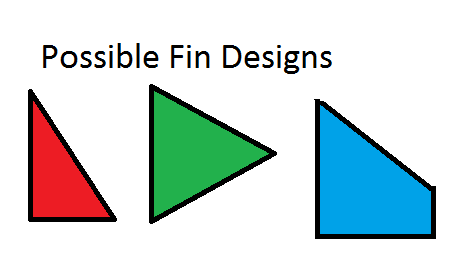
the fins for our rocket I used the NASA simulator. I found out that we would
get the best fins if we made them out of cardboard. I also found out that the
cardboard shouldn’t be too thick or it would increase the air resistance. I also
discovered that the fins should be trapezoidal so that they stick out of the
rocket to give it maximum stability, it would increase air resistance a little
but that was ok because we traded that for stability and height. There were
other detentions that I tweaked to help the rocket go a little higher but they
didn’t help that much.
Summary:
I thought that
overall our rocket was great. I am glad and surprised that we won the hang time
competition and I think we had a great rocket. I’m surprised that our rocket
won. It didn’t go higher than Aaron and Oliver’s but the parachute actually
deployed. I know that if Aaron and Oliver’s parachute worked than we would have
lost.
I think that we
could have improved our rockets a little bit. We could have made the nose cone
better so that we could fit the parachute but it still worked. Overall if we
had more time we could have made our rocket a lot better. I’m still glad we won
though.
Winners
We Won !!!!!!!!!!!! With 5.88s we had the longest hang time. It was the first time we got our parachute to deploy
We Won !!!!!!!!!!!!
We Won !!!!!!!!!!!!
We Won !!!!!!!!!!!!
We Won !!!!!!!!!!!!
We Won !!!!!!!!!!!!
We Won !!!!!!!!!!!!
Wednesday, May 30, 2012
Homework for Final
Jay- Write about the parachute (1-2) paragraphs. Write a reflection about our project (1-2) paragraphs.
Brett- Write about the fins (1-2) paragraphs. Write a reflection about our project (1-2) paragraphs.
Charley- Do the rest and put it together
Post paragraphs on the blog by Thursday night.
Tuesday, May 29, 2012
Parachute
We were planning on either using a circular, or rectangular nose cone. We had great difficulty trying to make the circular chute. The rectangular one was too large and it would not deploy. So we are using our parachute that is a half circle. We don't think think that the shape will matter much, as long as it falls properly, deploys, and has a large surface area.
Thursday, May 24, 2012


Wednesday, May 23, 2012
Reasoning
We used the simulator to find the best fins and nose cone. We also realized that 3 fins would work the best for our rocket. We added the two pieces of duck-tape to help secure our pressure chamber. We only used two pieces of tape because we want the rocket to be as light as possible. We are putting the parachute inside the cone so the center of mass will be higher up and in a better place. We used an elliptical cone because our results from the simulator showed that it was the best to use. On the internet, we learned that rockets going at sub-sonic speeds should have a rounded tip. This is why we put a marble at the tip of our nose cone. We made the cone out of a circular piece of cardboard because we thought that it would be most efficient, making it aerodynamic and light. Our simulator results showed that it is very important that the nose cone is light. We chose the Smart Water bottle, because it is smooth, long and thin, making it aerodynamic.Tuesday, May 22, 2012

Monday, May 21, 2012
Here is my Data Sheet:
Flight One
Body:
Payload Height (cm): ____7_____
Nozzle Radius (cm): ____1_____
Fairing: Yes
Fairing radius (cm): ___.606 oz/in3 (1.98)__
Nose Cone:
Shape: __parabolic______
Material: _1/16 hollow
cardboard_
Propulsion:
Water (liters): _ 50____
Pressure (KPa): __ 70___
Fin Design:
Fin Height: _5__
Fin Shape: _trapezoidal____
Number of Fins: _4___
Fin Dimensions: w=3.5, L.E. Ang=44,
T.E. Ang= 29
Launch Stats:
Max Altitude (m): __28_
Max Velocity (m/s): __42_
Flight Two
Body:
Payload Height (cm): ____10_____
Nozzle Radius (cm): ___1.5____
Fairing: Yes
Fairing radius (cm): __(3.79/2)___
Nose Cone:
Shape: ____spherical___
Material: ___solid plastic________
Propulsion:
Water (liters): 71.185___
Pressure (KPa): __ 78.302
Fin Design:
Fin Height: __8__
Fin Shape: _trapezoidal____
Number of Fins: _3___
Fin Dimensions: w=3, L.E. Ang=53,
T.E. Ang 50
Launch Stats:
Max Altitude (m): __9___
Max Velocity (m/s): __30___
Here is my spreadsheet data. I think I did something wrong though because both of my launches were kind of low.
Flight One
|
Flight Two
|
||
Body:
Payload Height (cm): 0 Nozzle Radius (cm): .317 Fairing: Yes Fairing radius (cm): 2
Nose
Cone:
Shape: conical Material: solid plastic
Propulsion:
Water (liters): .3 Pressure (KPa): 200
Fin
Design:
Fin Height: 2.0 Fin Shape: trapezoidal Number of Fins: 3 Fin Dimensions:12cm, 12cm |
Body:
Payload Height (cm): 0 Nozzle Radius (cm): .5 Fairing: No Fairing radius (cm): 3
Nose
Cone:
Shape: conical Material: hollow plastic
Propulsion:
Water (liters): .4 Pressure (KPa): 350
Fin
Design:
Fin Height: 9 Fin Shape: trapezoidal Number of Fins: 3 Fin Dimensions: 9cm, 9cm
|
Center of Mass
http://tclauset.org/21_BtlRockets/BTL.html (third video)
We want the center off mass to be towards the top of the rocket so it flies straighter. We can find where the center off mass is by balancing the rocket on an finger. The center of mass can be moved upward by adding weight to the nose cone. The rocket should weigh 200-240g.
Subscribe to:
Posts (Atom)